Mind Machine Learning · Conscious Beings · Visual revision
How UEMA builds perception of a world and a self
UEMA trains networks to connect what its body does with what its senses report next. The resulting patterns can become useful distinctions: contact, resistance, and the effects of its own movements. Other networks learn its bodily condition and predict how that condition will change. This gives our consciousness thesis a specific learning mechanism.
1. Where learned perception comes from
MIMo is the simulated body. UEMA is the learning system. A reach supplies several kinds of information about the same event:
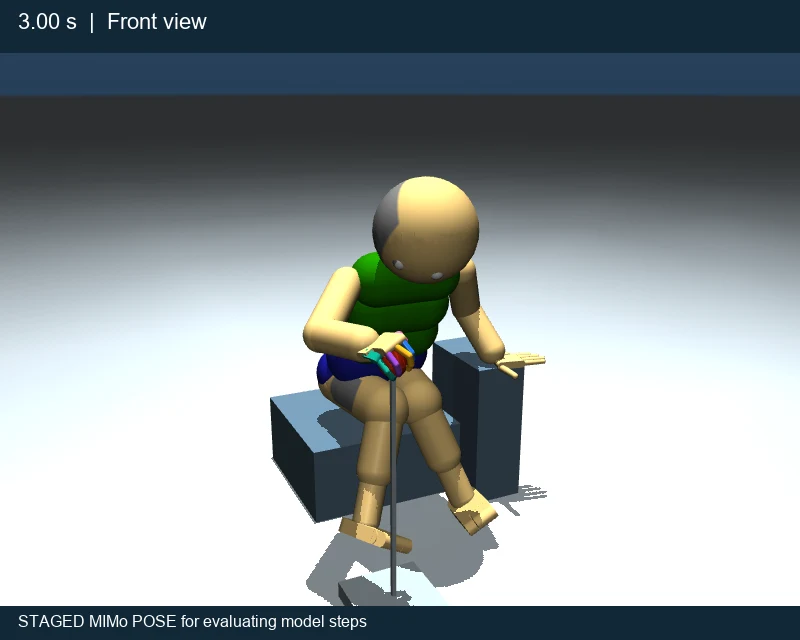
Staged MIMo pose for evaluating model steps.
SightImage patches containing the hand and ball.
TouchPressure and contact readings at skin sites.
Body positionPositions, turns and movement of body parts.
Motor informationAchieved body pose and the executed command.
Readings + recent history
Keep the senses, their times and the executed command together.
MIMo bridge
→
Learned encoders
Multiply and combine readings using learned weights. Produce a compact list of numbers, called a token.
EncoderRegistry
→
Forward model
Attention combines tokens across senses and time. Stacked neural blocks build on earlier combinations.
ForwardModel / ThreeStageBlock
Later, the body supplies ↓↓ Combined information
The body later supplies:
Actual next readings
Encode what really happened. Hold these target numbers fixed for this lesson.
→
Prediction error
For each value: subtract the actual token from the predicted token, square the difference, then average.
←
The forward model supplies:
Prediction heads
Small networks produce the predicted next token for each predicted sense.
PredictionHeads
↺ The error becomes a lesson. Backpropagation computes which weight changes would reduce the error. The optimizer updates trainable encoder layers, the forward model and prediction heads. A weight is a stored number that controls a network connection.
What creates the new perception? A difference matters to this lesson when preserving it helps predict a different outcome. Training can therefore build a useful distinction such as contact versus no contact without supplying those words as labels. Later network layers can use that distinction to represent more complex relationships. This is function begets function.
Where this sits in Perception Space v4
A perception space contains every observation the senses can represent. Each observation is one point in that space.
1. Sensor spaceAll possible readings.Movement visits different points.
2. Usable detailWhat the senses can tell apart.Body condition changes precision.
3. Encoded spaceThe learned tokens.Training changes their organization.
4. Functional perceptionUseful learned distinctions.New distinctions support new abilities and self.
The tokens can stay the same size while learning changes what differences they preserve.
One encoder, step by step: touch
The touch encoder takes a row of numbers for each skin site. A small network multiplies these numbers by learned weights, adds biases and applies a curved response called GELU. Further weighted layers combine the results. Attention then mixes information between sites. A learned pooling query combines the site results into one touch token. Where configured, a learned site identifier tells the encoder which skin location supplied a row.
Source: CrossPatchAttentionEncoder, patch_mlp, layers and pool_attn. The prediction lesson changes these trainable weights, so the retained touch patterns can change with experience.
2. How one sense connects with another moment
Attention computes learned matching scores between tokens, turns those scores into weights, and mixes their information. Each forward-model block has three attention stages. Select a stage to see which tokens it can combine.
Blue: the token being updated. Green: tokens it can read in this stage. Four input streams are shown. Colors show allowed connections, not measured attention strength.
Block 1→ 2→ 3→ 4→ 5→ 6→ 7→ 8
The master configuration repeats these stages eight times. Each block also has a small layered network that transforms the combined values and adds its output to the incoming values. Block count is configurable; meanings such as “grasp” are learned patterns, not assigned block names.
The attention calculation, in plain steps
Learned weight matrices turn each normalized token into three lists: a query for matching, a key to match against, and a value carrying information.
Multiply matching query/key entries and add them. Divide by the square root of the list length. This gives one matching score per readable token.
Softmax turns the scores into positive weights that add to one: exponentiate each score and divide by their sum.
Multiply each value list by its weight and add the lists. Several attention heads do this with different learned projections, then combine their results.
Prediction error trains the projections. The diagram shows which connections are allowed; training determines their weights.
How the prediction stays tied to the past
The time-only stage blocks later times. The across-both stage can read the entire supplied window. For the next-reading lesson shown here, that window ends before the reading being predicted. The answer enters only when the error is calculated. A lesson predicting every point inside a longer recording needs past-only windows or a time mask on every path that mixes times.
3. How the body becomes part of its own perception
UEMA tracks which changes accompany its commands and learns what condition its body is in. Wellness describes functioning such as sensing quality and available motor capacity. The two paths below connect body experience to that evaluation.
Body schema: track movements that happen together
Changes in commands + sensed body changes
↓
Command/sense comparisonsTrack the size of command changes alongside sensed body changes over experience.
↓
Body membership estimatesCan supply the extent-of-self term in wellness.
This path uses running statistics. An outside object's membership also compares its reported movement with body movement. The extent route uses body_schema_updates=on and wellness_coherence=extent.
Self perception: learn a changing bodily condition
Skin function + motor capacity + sensory history
↓
Encoders + recurrent network + attentionCombine current readings with retained self history.
↓
Learned self state + timed commandsForecast bodily function after those commands.
↺ Learning: compare the forecasts with later measurements and update the self networks.
Completed main-model state→ retained for the next moment →Next self-state input
The added values reach prediction heads and movement computations. learn mode teaches self state without adding it to the main model. A recurrent network carries state forward from one moment to the next.
Measured current function and learned forecasts are separate
With self_prediction=grounded_residual, the forecast starts from measured current bodily function. The separate learned_present output is still trained against measurements. The present measurement, the learned self representation and the future forecast are three different things.
What carries experience beyond the recent window?
PersistentMemory combines stored events with their elapsed times using a recurrent network, then uses learned attention to retrieve prior states. A learned readout adds information to the forward model's final tokens. This is a separate memory path from the self network's own retained state.
4. Why these mechanisms matter to consciousness
The prediction system can represent consequences; the self mechanisms connect consequences to this body's control and condition. Intention uses learned predictions to search for commands whose consequences match a goal. Wellness helps select which remembered outcomes become goals.
A concrete way bodily condition changes perception
Local contact load
→
Lower touch precision
→
Pressure and shear rounded to coarser steps
→
Changed input to the touch encoder
This is the body_function=modulate path. Recovery can restore precision. In the same mode, fatigue reduces available motor force, changing the movement and the next sensed outcome.
The wider Perception Space thesis
Body state can change what is sensed, its learned representation and how learning proceeds. Separate optional activity settings change sensory gain and learning rate. Gain scales values; it is different from the touch-precision path above. The broader patent design also covers changes to computing resources.
In Many Minds, a specialist receives selected sensory inputs while the parent retains the full set. Mastered skills retain prediction and wellness within their own minds. This extends the learned self across a hierarchy of abilities.
Our thesis is that conscious awareness can emerge from this developing, self-related perception. The model learns distinctions about the world, learns its own place and condition within that world, and uses those representations to shape further perception and action. These connected learning processes are the substance of the proposal.
Reviewed November 1, 2026 by Codex and two independent reviewers. Source and clarity checks corrected encoder detail, self-feedback arrows, body-membership wording and the phone comparison layout. Desktop and phone views inspected; attention controls checked.