Each eye has a 256 × 256 RGB wide view covering 60°, plus a 288 × 288 central view covering 24° for detail.
Mind Machine Learning · Conscious Beings · New visual revision
From a first touch to a growing self
We are building UEMA toward conscious AI. Its starting point is a body whose movements, senses and condition matter to the learning system inside it. Experience should build a growing understanding of what forms my body, what I can do, and what will help or harm me later.
MIMo is our simulated body. MuJoCo calculates its physical movements and contacts. UEMA learns from the resulting senses. A simple-looking body can supply a rich life of bodily experience.
1. Much more is happening than the picture shows
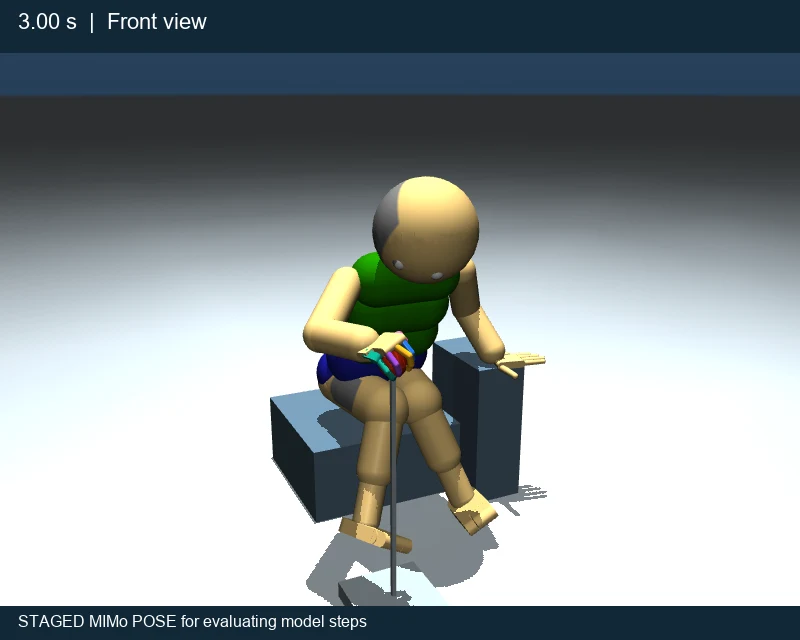
4,683 skin sampling points across 53 sensing body parts. Contact forces supply pressure, sideways force, slip, area estimates and vibration features.
Positions, turns, speeds and available motor capacity for 26 tracked body/gaze elements. The applied movement command is recorded separately.
A head accelerometer and gyroscope each measure three directions. UEMA adds neck, trunk, support, effort and fatigue information.
256 frequency bins per ear, from 40 to 8,000 Hz. Scene events and recording-derived sounds supply a left/right sound picture, with arrival-time and loudness differences.
These camera and skin figures describe the checked 24-month MIMo configuration. Sensors are simulated. UEMA can change the body configuration and which inputs a run uses.
A new ability changes what the mind can experience next.
A hand closes. Pressure changes. An object moves with it. Learning the relationship makes holding possible. Holding opens further experiences: turning the object, carrying it, comparing its weight and using it to affect something else.
ExperienceMovement produces connected changes in sight, touch and body condition.
New perceptionLearning makes useful relationships distinguishable and predictable.
New abilityControl opens further experiences and new consequences for the self.
↶ Those new experiences become the next lessons. Function begets function.
This is the scale of the ambition: the knowledge, abilities and purposes of the system develop together. As its perception grows, so can its understanding of what is possible for itself and what is worth pursuing.
The advantage is whole-body experience. When a hand presses its own arm, contact can be registered on both body surfaces. When that hand presses a ball, the hand's contact changes together with the ball's movement. Vision, touch and movement supply different evidence about the same event.
This gives self-learning more evidence than a camera-and-joint-only setup, or touch confined to fingertips. It can connect a loaded foot, a slipping hand, a turning head and tiring muscles within one body. Simulation also lets researchers repeat the same situation and change one cause at a time.
What MuJoCo touch supplies, and what we add
MuJoCo contacts
The physics engine calculates contact forces. Its basic touch sensor returns the sum of normal forces in a sensor zone.
→
MIMo skin
Our configuration uses three-dimensional force vectors, including friction, distributed over nearby skin sampling points.
→
UEMA readings
The bridge derives pressure, sideways force, slip, estimated area and four vibration bands from contact forces, geometry, movement and force history.
Those vibration bands are 5, 10, 15 and 20 Hz. Contact area depends on the selected contact model. The bridge groups skin information into body-part inputs and retains local condition summaries; 4,683 samples are not 4,683 separate full-feature neural inputs. MuJoCo sensor reference · MIMo touch system · UEMA touch adapter.
Verified details and a fair robot comparison
The balance packet has 29 fields: 28 sensory/body values and a validity flag. The flag checks whether the reading is usable. MIMo also exposes joint angles, velocities, torques and joint-limit information; the 26-element UEMA body representation is a distinct interface. Available strength is calculated by the fatigue model.
MuJoCo itself does not generate audio. UEMA synthesizes event spectra and supplies stereo information. This supports sound-guided learning without claiming a complete physical room-acoustics model.
Robots differ. Unitree's published G1 specification lists depth vision, LiDAR, microphones and joint encoders, with optional hand tactile arrays. Our emphasis is detailed skin experience over the body, linked to changing sensing and movement capacity. That is a specific advantage for studying a bodily self, rather than a claim that every robot has fewer senses. Unitree G1 specification.
2. What we mean by a self
A developing infant has a body long before it can explain itself in words. UEMA follows that starting point: movement produces sensations, those sensations reveal bodily condition, and experience links the two.
What changes when I act?
A command moves the hand. Its position changes, its image moves and contact may appear. Repeated relationships help distinguish the body's controllable parts from surrounding events.
How am I functioning?
Can this hand still push? Can these skin sites still distinguish contact? Is the body supported? The self representation combines such readings with experience.
What will this mean for me?
Continuing, releasing or changing a movement can lead to different bodily conditions and different things the body can do afterward.
The homeostatic self is the learned representation of the system's own functioning and what sustains it. “Homeostatic” means keeping a body able to function as conditions change. In UEMA, development also means gaining useful control, better distinctions and wider access to the world.
Its condition reaches inside perception. In UEMA's modulated body, local loading can make touch readings less precise, and fatigue can reduce the force a movement produces. Those changes alter the next experience. The body supplies the consequences; learning must connect them to their causes and to possible recovery. This gives the self something concrete to learn about its own vulnerability and capacity.
Wellness is how that self is doing. It includes functioning senses, usable strength and retained abilities. A comfortable body can still benefit from exploration. Practice may take effort now and make a useful ability available later. A mastered ability remains useful even when it is no longer surprising.
Why sensor readings alone are not the learned self
A measured strength value reports current capacity. Neural networks learn relationships among capacity, contact, movement and history, and forecast later function under timed commands. A separate body schema tracks movement associations. These are different contributions: measured condition, learned representation and predicted consequence.
The principle comes directly from the earlier wellness-as-self discussion and homeostatic-self plan. A comfort formula alone cannot replace that chain.
3. One purpose, several changing actions
Take a bowl of water into the next room. MIMo starts at the dark pickup table, away from the door. Both hands help keep the water level. The closed door creates a new need: set the bowl on the lighter side table, free a hand, open the door, then come back for the bowl and carry it through.
These MuJoCo renders show one journey. Both tables stay in place, and the same door opens on the same hinges. Select each numbered scene to follow it.
Perspective:
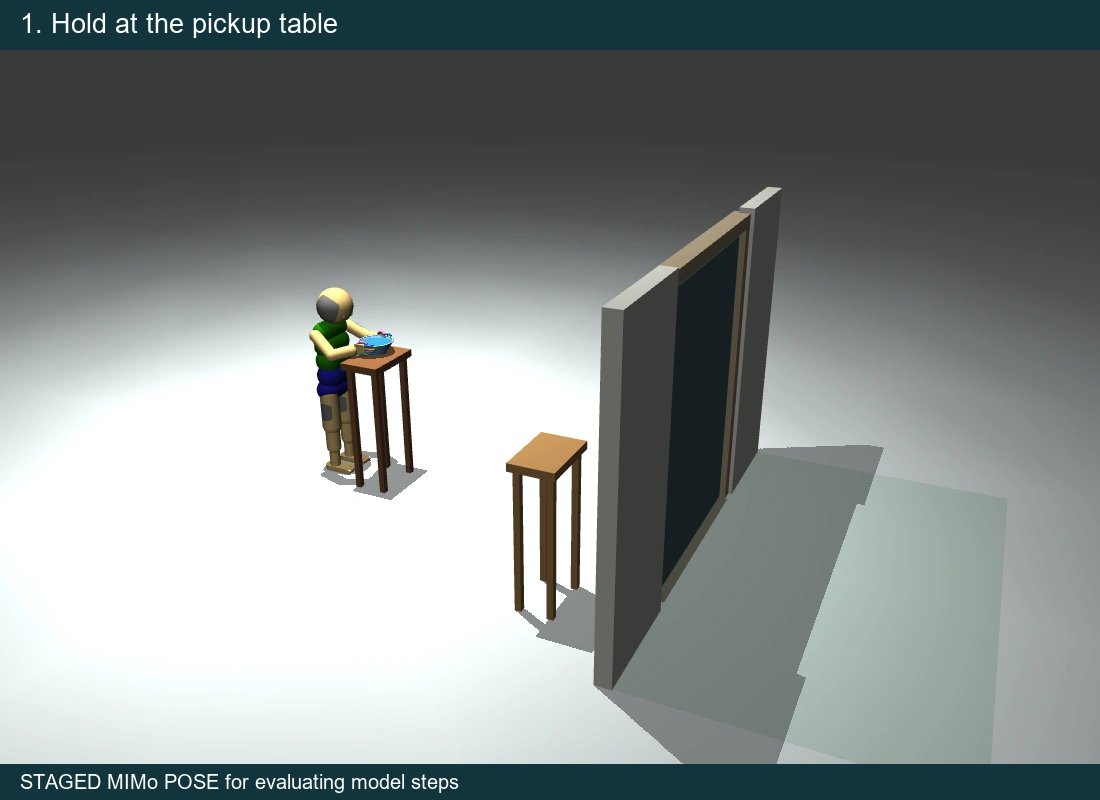
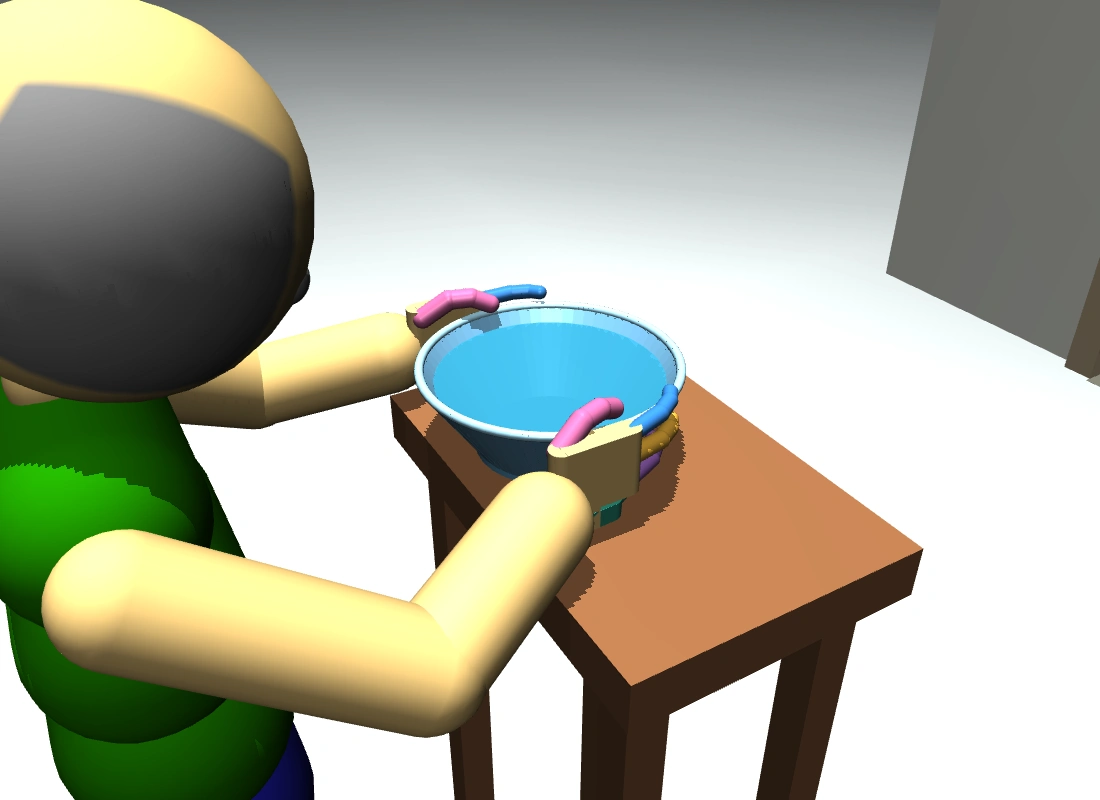
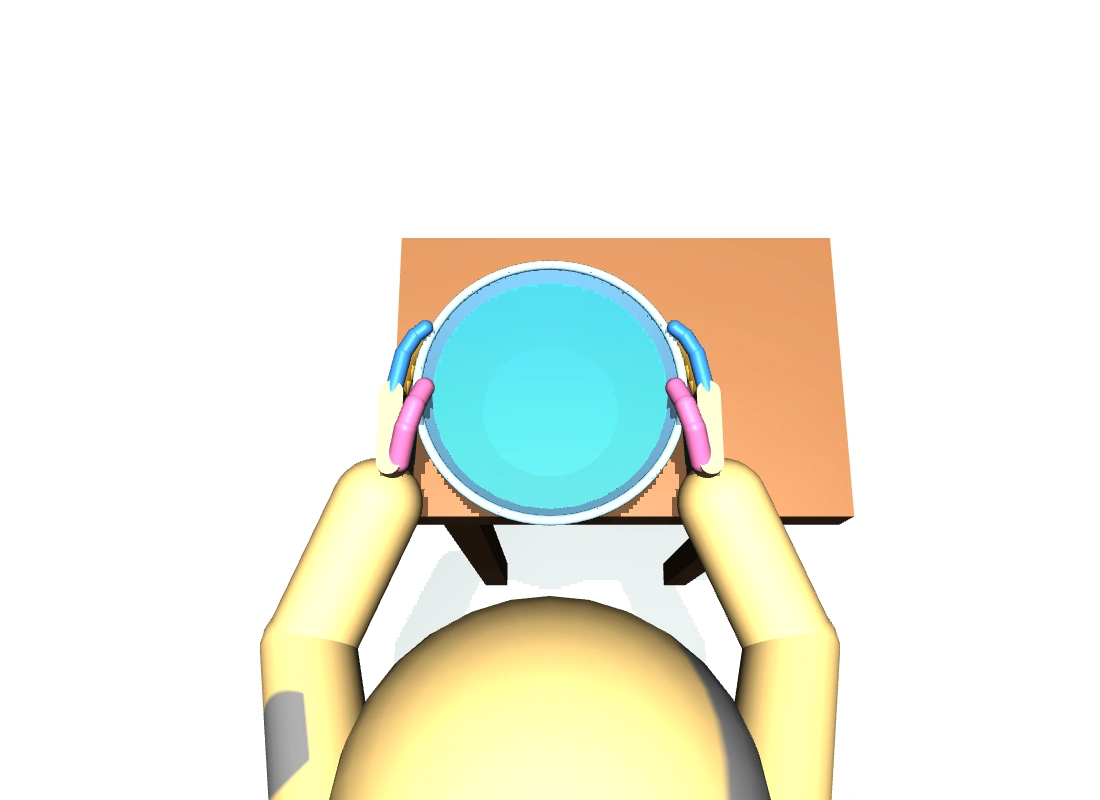
The purpose stays the same. Holding, walking, putting down, opening and picking up serve the same continuing aim: take the water into the next room. The final scene shows MIMo, the bowl and both feet beyond the doorway.
Contact gives informationThe hands meet the bowl and sense where support begins.
Control lasts through movementBoth hands keep the bowl level while the body changes position.
The next aim can changeA closed door makes setting the bowl down useful.
The larger purpose continuesOpen the door, return for the bowl and carry on.
A learned ability is useful beyond the movement that first taught it. Holding enables carrying. Recognizing a stable surface makes it possible to free a hand without losing the bowl. Remembering the continuing purpose connects putting down, opening and retrieving. The developing self connects what the body can do now with what it can make possible next.
What if the journey stops going to plan?
The room can look almost unchanged while the situation becomes very different. A bowl starts to slip. A door sticks. A grip tires. Useful situational awareness means tracking what is changing, what the body can still do, and what its next movement will cause.
The bowl slips
Pressure shifts across the fingers. Sideways contact motion can reveal slip before a camera shows a large movement. The next command needs to restore support or lower the bowl to a surface.
The door sticks
The arm pushes harder, but the door barely moves. Effort and balance change. Repeating the push may cause a fall; changing the stance or releasing pressure may preserve control.
The grip tires
The bowl looks the same, but the hands have less capacity left. Continuing may drop it. Putting it down can restore the ability to carry it onward.
These examples require a shared picture of the object, the body and their recent interaction. Counting sensors is not enough. Their readings must change the next prediction and command while movement is happening.
1. Sense the change
Combine sight, contact forces, body position and balance with recent commands. Include the body's changing capacity.
2. Predict the consequences
Use learned relationships to predict how different commands would change the bowl, support and bodily condition, both next and later.
3. Adjust and learn
Choose the next command using those forecasts. Compare the actual outcome with the prediction; use the difference to improve future predictions.
The self changes what is worth doing next
UEMA's design connects this loop to a learned perception of its own functioning: support, effort, fatigue and the ability to keep controlling its body. Dynamic intention means changing the immediate aim as those relationships change. Carrying can give way to resting the bowl, while taking the water onward remains the purpose.
The advantage we are building toward is a self that develops with experience and changes both how to move and what to pursue. Learning a new grip opens new possibilities. Learning what leads to lost control changes which possibilities are worth pursuing. The responses above are outcomes to learn through prediction and experience, rather than a separate rule for each mishap.
How this compares with current robot AI
A vision-language model (VLM) interprets pictures and words. It can plan a task while a separate movement model controls the body. Google's Gemini Robotics ER 2 uses continuous video to track progress and adjust when a step goes wrong. Its companion Robotics 2 model controls whole-body movement. Google's ER 2 description; Robotics 2 architecture.
NVIDIA's GR00T N1.7 produces movement commands from images, body readings and instructions. NVIDIA reports up to about 36 new command sequences per second on its listed hardware and settings. The motors can execute between these updates. GR00T architecture; inference measurements and settings.
Another route is to predict possible futures and repeatedly choose movements toward a goal. Meta's V-JEPA 2-AC demonstrates this with a supplied goal image; V-JEPA 2.1 develops visual learning across space and time. Meta's planning example; V-JEPA 2.1 paper.
Speed and the ability to revise a plan already exist in leading robot systems. UEMA's research focus is how intention develops: learning how the world affects this body's functioning, and letting that learned self shape the futures it pursues. A camera-only system can miss a change in grip capacity; a body-aware system can use it. UEMA aims to make that bodily knowledge central to developing perception and purpose.
The meaningful comparison: introduce an unexpected slip, extra door resistance or reduced grip capacity. Measure how quickly each system corrects, how much water spills, whether balance is preserved and whether the journey continues. Use the same body, sensor access and test surprises, and report training and computing costs. Also compare UEMA with and without its learned bodily forecasts, keeping the rest the same. This separates recovery skill from the benefit of the learned self.
4. How perception grows without adding a new sense
An eye can produce many possible images. A perception space is the set of observations a sensor, or a combination of sensors, can represent. Learning changes which differences become useful to the system.
1. Possible readingsThe available images, pressures, movements and sounds.
2. Available detailHow finely the senses distinguish those readings. Bodily condition can change this.
3. Learned encodingNetworks convert readings into compact number patterns, called tokens. Experience changes their weights.
4. Useful distinctionsContact versus no contact. Supported versus slipping. A free hand versus one needed for support.
Moving the hand visits different points in the sensory space. Training changes how those points are represented. Later neural layers can combine earlier distinctions into new relationships: contact supports holding; holding enables carrying; putting down enables a different useful action. This is the meaning of function begets function.
The growing self belongs here: it is bounded by what the system can distinguish about its own control and consequences. The representation can gain useful distinctions while its number of stored values stays fixed. With more experience, a tool can matter because it extends reach; a place because it offers reliable rest; a caregiver because their actions have repeatedly brought comfort, recovery or learning. These learned relationships can sustain the self without becoming parts of its physical body. Functionally, though, they can become part of that self: if a caregiver's support is lost, wellness falls, and restoring that support or finding an effective substitute becomes a goal.
What specifically in UEMA makes these relationships learnable?
Each encoder uses learned weighted layers to turn a sensory stream into tokens. Forward-model blocks use attention in three stages: across senses at the same time, through time within one stream, and across both. Matching scores determine how much each readable token contributes. Successive blocks transform those combined patterns. Prediction heads produce the expected next sensory tokens.
Later actual readings supply the teaching targets. Squared prediction differences drive weight updates through the encoders, forward model and heads. Preserving a distinction is useful when it helps predict a different outcome. That is the mechanism for learning structure rather than relying on named categories supplied by a writer. Interactive attention diagram and exact calculations.
5. The complete connection from experience to intention
The forward model predicts consequences. The self-state networks learn bodily condition and forecast its change. The intention planner compares candidate commands using predictions. The full design below compares possible command sequences with their timing.
The full connection the UEMA design requires:
Read the world and body
Images, contact, position, balance, sound, capacity and executed commands supply a timed history.
Calculate possible outcomes
Combine that history with each candidate sequence. Predict later senses, motion and bodily function.
Relate outcomes to this self
Compare continued control, functioning and useful opportunities, including temporary effort and later effects.
Select an attainable future
Use the comparison to select a goal and its first command. A useful first move may enable a later benefit.
Produce a physical change
Motors apply the command through body mechanics. New contact, support and sensory readings follow.
Check what really happened
Compare predictions with actual outcomes. Update learned relationships and revise the remaining sequence.
Two lessons close the loop. Predicted senses are compared with later sensed events. Predicted bodily function is compared with later measured function. The first teaches what can happen; the second teaches consequences for this self. Both depend on the actual executed commands and elapsed time.
This is the full UEMA design requirement. The model-connections audit explained why a chooser that only returns to a remembered pose does not fulfill it. Future self forecasts must influence the actual command comparison.
Contact changes the body
Local load can lower simulated touch precision. Fatigue can reduce available motor force.
→
Changed function is experienced
Coarser pressure readings reach the encoder. Reduced force changes motion and its consequences.
→
Prediction can become avoidance
Learned forecasts can identify the same loss before it occurs, so the command comparison can favor a different future.
We call consequences like these digital pain and pleasure. They run both ways: a beneficial interaction can improve function just as a harmful one reduces it, and an anticipated benefit can favor a command just as an anticipated loss counts against it. Beyond touch precision, the design lets interactions change a sensor's dynamic range and processing settings.
Imagining impaired touch should not impair the real skin. The forecast describes a possible future. Actual impairment comes from the body's interaction. And accurately predicting an impaired sense must not make the impairment count as wellness.
Where training stands. Today's training is self-supervised: nobody labels the experience, and we engineer the objectives. Alongside live prediction, replay revisits recorded experience, imagination trains predictions across successive commands, and the motor controller learns from the body positions it actually achieved. Wellness calculations score bodily condition and interaction outcomes, and those scores help today's planner select remembered sensory states as goals. That is the chooser mentioned above, the one the model-connections audit found only returns to a remembered pose; comparing whole future sequences is the part still being built.
The training program is organized around demonstrated physical abilities, tested for repeatability, retention and transfer. Infant development supplies the catalogue. Bodily learning and some functional modulation are implemented. The broader connections between an expanding self, anticipation and intention remain under development, and how far the self develops depends on experience, the simulated environment and model capacity.
Where the implemented self connections enter
Self-state encoders, recurrent memory and attention combine body-function readings with retained history. Timed commands condition future-function forecasts, which learn from later measurements. In perceive mode, a learned self-state projection adds values to the forward model's latest output tokens; learn mode trains the self state without adding that feedback. The completed main-model state is retained as an input to the next self observation.
These representation paths are separate from choosing among future sequences. Enabling a self network alone does not enable the complete comparison shown above. The current code-to-architecture guide explains those separate controls. The contact-to-precision route uses body_function=modulate.
6. Learning how the world works gives the self room to grow
Physics connects the senses. A supported bowl and a falling bowl produce different changes in sight, touch and movement. These are related observations of one event. Learning to predict them builds knowledge that can serve many later purposes.
Fingers contact the bowl
→ grip supplies support
→ hand rises with the bowl
→ load remains at the hand.
The relation among these changes can help with another object's shape or weight.
Hand rises
→ unsupported bowl rises with it
→ no contact or other lifting force.
Ordinary unassisted experience supplies a different outcome. The prediction lesson can correct the mismatch.
Researchers can model parts of this physical structure as a manifold: a constrained space of related states. In plain terms: the world allows some combinations and rules out others. UEMA learns from those relationships, while wellness gives them significance for the developing self.
One interaction supplies many lessons: where contact began, how load changed, which movement followed and what capacity remained. Our hypothesis is that this rich learning can acquire useful abilities efficiently and reuse them in new situations.
What the comparison with reinforcement learning actually means
A reward-only success signal says much less about an event than the event's full sensory consequences. But model-based reinforcement learning also learns predictive world models, as Dreamer demonstrates. UEMA's case rests on the combination: grounded bodily experience, learned self-related perception, wellness-dependent sensing and development of intention. A claim of greater learning efficiency needs a comparison using matched experience, compute and ability tests.
The aim is a being whose world has significance for its own developing self. A first touch can begin a chain of learning that changes what the system can perceive, do and anticipate. UEMA's consciousness thesis puts that growing, integrated perception of world and self at the center. We are building toward a mind whose experience matters to it.
Sources, checked specifications and revision notes
- Perception Space v4: four layers, physically structured learning, function begets function and an expanding functional self.
- Homeostatic Self and Intention plan, September 12 discussion, and September 9 reconsideration: functioning, healthy discovery and future consequences.
- Model-connections audit: the missing distinction between choosing a past pose and evaluating a future sequence. Its dated run status is historical.
- MIMo environment, configuration, recorded skin-count receipt: vision and skin figures.
- Touch, proprioception, balance packet, audio: exact input definitions.
- Forward model, self networks, self integration and body-function modulation: mechanisms and conditional connections.
Codex revised the journey and robot comparison on November 2, 2026. Independent review checked all 32 MuJoCo images, scene continuity, finger placement, desktop and phone layouts, and the comparison's sources. Review corrections clarified the walking pose and separated general recovery skill from the contribution of the learned self. Geometry checks caught and corrected an arm crossing the doorframe during opening. Review record and corrections.